A Huge Thank You

DSC00504_med
Hi friends,

We have been incredibly humbled by your huge heart and generous spirit. We are so proud to be ending our Kickstarter campaign with over $36,000 raised from 373 different individuals. Thank you for caring about the cause of global equality and for making a difference at such a pivotal time in the history of lesbian, gay and transgendered rights.
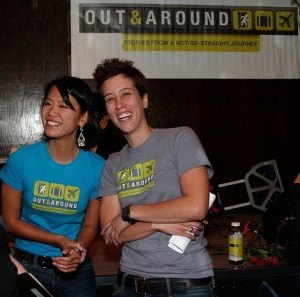
With this money, we have enough to take us through the post-production process and get this film made. This is a huge achievement, and we cannot be more proud of how far this project has come since we first came up with the idea to “find the Supergays” over 2 years ago.

We will continue to apply for grants and look for other sources to fund the distribution and community organizing expenses of Out & Around, as our hope is to truly make a wide and actionable impact with this film. But now that we have raised the bulk of our budget, we are confident that this film is going to get made and watched by people all over the world. We are targeting to have the film completed by the end of the year.

Lisa and I, along with our film producers Lauren and Susan, would like to introduce a couple of new people on our team. We are thrilled to have Ryan Suffern come on board as editor and producer.  Ryan has worked on films of all kinds over the past decade, from independents to working with the likes of Steven Spielberg and Frank Marshall. He recently finished editing the award-winning documentaries Right to Play and Bidder 70 as well as the upcoming Running Blind. Ryan’s passion is to use filmmaking to tell stories that make a difference, and we cannot be more excited to have him on board the Out & Around team.

We are also excited to bring on marketing guru, community organizer, LGBT activist, world traveler and all around superwoman Leanne Pittsford to head up the distribution and community activism part of this project. Leanne is CEO of Start Somewhere, a marketing agency  on a mission to help profits and social enterprises grow and fund their vision. Previously, she was a senior director at Equality California, the largest statewide LGBTQ organization in the US. She has used her tremendous energy to make a difference, and we are excited to harness her talent to make Out & Around a catalyst for changing hearts and minds around the world.

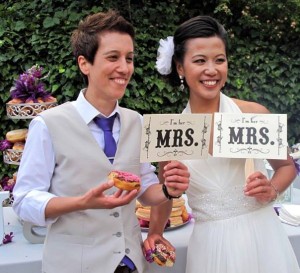
So what’s next? Well, the big news is that Lisa and I are getting married in a month! As we were sitting down together to write our vows a few nights ago, we’re just both blown away by how much has happened for us on a personal level and on a macro level. Just this month, we saw marriage equality pass in France, New Zealand and Uruguay. The other day we were walking by a public school in our neighborhood and saw a huge bulletin board celebrating LGBT leaders.

We do not take any of this granted, and we realize what a huge privilege it is to be able to stand in front of 150 loving and supportive people on June 8 to celebrate our wedding vows, even if the State does not yet recognize it. And in this detail, we are hopeful change will come soon.

This is an incredibly exciting time. Thank you again for your support of this project. This is for all of us.

Jenni, Lisa, Lauren and Susan


Trailer Release: Help Bring our Supergay Journey to the Big Screen

J&L tshirtsOur journey did not end with the last plane ride home from Lima to San Francisco. For the past eight months, Lisa and I have been working to finish the project we started when we decided to leave our 9-5 jobs, pick up a video camera, and travel through Asia, Africa and South America in search of the people who are leading the movement for gay, lesbian and transgender equality.

After bringing our project to many different filmmakers, we decided to partner with producer and director Lauren Fash and Susan Graham. Once you watch their award-winning film Quiet and hear their passion about human rights, you’d understand why we felt they were the right people to take our ‘baby’ and bring it to life.

Today, we are releasing the trailer of our film and kicking off a $30,000 fundraising campaign to pay for post-production costs. Could you give me a couple minutes of your time to be a part of this project that we feel so passionately about? Here’s what you can do:

1) Watch the 2-min video trailer of our film.

2) If you are moved by this story, consider giving your financial support and earn some Out & Around swag. If you’ve already donated, thank you thank you thank you!

3) Tell your friends about us: Like our Kickstarter site on your Facebook page and share a message about this project to your network. We really could use your help to spread the word.

With this film, we have an opportunity to tell a very personal story about what is happening in the gay rights movement around the world. But this story isn’t just about the gays – this story is about the right to find respect, acceptance and love for any person who has ever faced intolerance for being who they are.

Thank you so much for following our journey around the world and for your incredible support through these past two years. Let’s bring the Supergay story to life and make a difference in the global movement for equality.


A Fair-Weather Activist No More?

What is it that drives people to devote their lives to fighting the status quo for the sake of progress?

This is the question that I find myself asking every Supergay that we interview. Why does a young Cambodian man like Srorn Srun, who has every reason to focus on bettering his own lot in life, decide to devote his time to organizing support groups for lesbians? How come two ministers in Kenya, both straight men with families, are willing to put their reputations and even lives on the line in order to help fight religious homophobia in East Africa? And what motivated Jean Wyllys to use his celebrity status as the winner of a popular reality TV show to enter politics and become an LGBT activist in Brazil?

It’s hard to get a straight answer on this question, but I’m coming to the conclusion that do-gooders like our Supergays are driven by a mix of empathy, conscience, and an audacious belief that things don’t have to be this way. In every case, the individual has personally experienced the injustices faced by lesbians, gays and transgendered people in their community. Recognizing that they have resources that others lack, their conscience drives them to use what they have to help others. And as for the audacious belief – most of the Supergays we’ve interviewed started their activism after witnessing models of the LGBT movement in more progressive parts of the world. Sunil Pant lived in Japan and studied the gay movement in the West before returning to Nepal to fight for LGBT rights in his own country. Xiangqi never considered community organizing for lesbians in China until she learned about the movement in Hong Kong and Taiwan.

I’m always amazed at how much good one passionate and committed individual can do in the world. So now that Lisa and I are back at home, the question I keep asking myself is: How much am I willing to devote my life to do the same?

Admittedly, I went on this trip for a whole bunch of selfish reasons. Who wouldn’t want to take a break from life and travel the world, meet amazing people, and spend a year with their partner and best friend? If I give myself an honest assessment, I’m a fair-weather activist. I do it when it’s convenient or useful for me. Does the marriage equality rally fit in with my weekend plans? If yes, okay. If no, sorry but I’m too busy.

Now, there’s a healthy dose of selfishness in the work of every activist. But there’s something more beyond mere selfish interest that drives people to fully devote themselves to human rights work, and again I’m concluding that it boils down to an above-average amount of empathy, conscience, and audacious belief.

In me, these qualities are being put to the test now that I’m back in “normal life” with a 9-5 cubicle job, a house, and a full social schedule. Empathy becomes difficult when your life is comfortable and the challenges of gays and lesbians in the developing world are an ocean away. Conscience becomes buried under the demands of daily life. And as for audacious belief – Can I really imagine a world where being gay, lesbian or transgender is viewed as just another dimension of human diversity rather than being the source of such vicious moral and religious debate?

The trip portion of Out and Around is over. But our mission isn’t. To be honest, Lisa and I are trying to figure out how we continue the work we started now that we’re home.  I’m often brought back to this quote by E.M. Forster: “One person with passion is better than forty people merely interested.” While I don’t know where we’re going to go next with all of this, I do know that to be a Supergay requires a superhuman passion that is anything but fair weather.

Gays versus Religion: My Journey

Six years ago, I found myself sitting in a cramped living room surrounded by the pastors and elders of my church.

The mood in the room was somber. I could tell that one of the church elders, a good friend of mine with whom I had traveled to China on a missions trip, had been crying. Being that our church was one of the largest evangelical churches in San Francisco’s Silicon Valley area, I didn’t personally know all the people in that room. But everyone there knew everything about me.

I suppose I should have felt ashamed for what I had done. But instead, I felt a strange sense of relief.

Like two defendants on trial, Susannah and I had been summoned to this private meeting in order to discuss our ‘situation.’ A third party had informed the pastors on our relationship, and needless to say they were far from pleased to hear that two ministry leaders in their church were carrying on an illicit homosexual affair. Our head pastor launched into a biblical argument on how homosexuality is a sin, highlighting the usual clobber passages and telling us that we were committing a grave error. We could be saved though, he said, if only we would turn from our ways and end the affair.

But Susannah and I were prepared for this, and we responded that we would not end our relationship. We didn’t have answers for all of the pastor’s biblical arguments, nor could we say for certain whether God was for us or against us. The only thing we knew was that we had experienced something about ourselves that completely changed our worlds. And for us, there was no turning back.

Perhaps the church leaders felt pressure to do something because we were active leaders in the church, perhaps they earnestly felt they were acting out of some righteous love, or perhaps they were simply ignorant. Whatever it was that motivated their actions, it doesn’t mitigate the pain that both of us felt when we were asked to leave the church. The church was our community, our family. These were the people that I celebrated my birthdays with and spent my weekends hanging out with. I tried holding onto them, but I finally realized that this was a losing battle when a good friend from the church requested that I not join his volunteer group at a homeless shelter. I still remember holding Susannah one night in her car and crying together over all of this.

But we were the lucky ones. When I came out, I was already 25 years old and financially independent. So when my religious conservative parents found out a few months later, I was able to move out on my own and escape from their disapproving influence. We eventually found a new church led by Supergay Pastor Maria home that affirmed the LGBT community. And while our relationship has ended, both Susannah and I can honestly say that coming out and ‘losing’ the church was the best thing that ever happened. We didn’t lose our spirituality – what we lost was a fixed and narrow lens of judging ourselves and the world.

Unfortunately, our stories are not unique. So many queer people across the world have suffered discrimination, violence, and worst of all, self-hate as a result of the church’s teachings against homosexuality. When we interviewed Supergay Manny Castaneda in the Philippines, he told us, “as long as the Church will tell the Filipinos that homosexual activity is a sin, the Filipinos will not allow the gays to have equal rights.” In Brazil, Supergay Congressman Jean Wyllys gave us the news that “a member of the evangelical Christian front presented a bill in Congress to implement treatment to cure homosexuality.” In Kenya, Supergay David Kuria showed us a website started by an American Evangelical that threatened his life. Kuria said, “I was really scared at that time because they were asking for me to be killed. There are people here who kill out of a religious obligation.”

The battle of the gays vs. religion isn’t just some kind of theological debate – it’s a real flesh-and-blood struggle with devastating consequences. Under these circumstances, it’s easy to paint the church as the ‘bad guys.’ But while I’m not trying to excuse homophobic behavior, I believe that religious people aren’t altogether bad people – they’re just been taught a very black and white view of the world, and they can’t see (or won’t see) outside of that view.

When I think of my parents, I have compassion for those who believe in the church’s homophobic teachings. My parents are good-willed, hard-working, family-oriented people. I know my parents love me, and it absolutely breaks their heart that our relationship has deteriorated. If they could find some way to reconcile their religion with my being gay, I believe they would take it. So often, I wish I could just grab their shoulders and convince them: You don’t have to reject your daughter in order to be a Christian. You can accept her just the way she is, and leave any judging to God alone.

But so far, my words have been futile. For the past three decades, my parents have been fully immersed in the Chinese evangelical christian movement, and what they believe is what they’ve been hearing from their church leaders every Sunday service and every Wednesday bible study. If we want to change the attitudes of the religious right, the change has to start from the top.

The interview that’s stayed with me the most this year is of two ordained reverends in Kenya
(Rev Kimindu and I shown left) who are educating religious clergy across Africa with a positive message on homosexuality. It’s tempting to throw stones back at the religious right when it feels like they’re heaving boulders at us all the time. But perhaps the best thing we can do is to show them the respect we wish they’d show us, engage in those tough conversations, and have faith that love will win out in the end.

Laura Hallberg, “Mrs. H’s Club”

One of the most enjoyable parts of Out & Around has been connecting with other queer community. This week we post a story from Laura, a teacher in the East Bay who has been following our journey and wants to share her own. Laura, thank you for contributing this story and for your service in our public school system.

Ms. H’s Club

I really should’ve known that my students didn’t care that I was gay when one day, earlier this year, one of my students asked, “What’s the GSA?” and another blurted out, “That’s Mrs. H’s club!”

I couldn’t do anything but laugh — “my” club, like I was recruiting or something. I’m a late-bloomer… I didn’t come out until I was 34 and up until then, I kept a wedding picture with my now ex-husband on my school desk. I laughed nervously when students would tell me that they thought I was gay until I talked about “my husband.” I would joke with my now-wife and say that my students knew I was gay before I did and she would say, “No honey, they accepted that you were gay before you did!”

I’ve been a teacher for 17 years at the same school in Concord, California, just a few miles from the gay mecca of San Francisco. Coming out at work after 10 years there was a little, shall we say, uncomfortable for me. Many of my colleagues knew me at the beginning as the “single new teacher”, and they celebrated my wedding to my husband. But I didn’t talk about my divorce in 2007, nor did I discuss my new identity as a lesbian.

When my wife and I were married in the summer of 2008 (during those brief months it was legal here in California), I didn’t stand up with all of my other colleagues on the first day back to school when my principal asked all the newlyweds to stand. I’m not sure what I was afraid of. I suppose I was worried about what my students would think. How could I explain that last year I was married to a man and this year, I’m married to a woman?

I would tell my wife that I didn’t have to answer to anyone because it was my personal business and not something I needed to talk about. “But you talked about your husband, didn’t you?”, she would ask. Finally, I had to admit to myself that maybe I was a little ashamed.

But then a shift in me occurred, and I began to stand up for myself. During a faculty icebreaker game, everyone had to guess a mystery person based on a set of clues. One of the clues stated that this mystery person had a wife. A new colleague suggested that this person must be a man to have a wife, but I politely disagreed and said that I had a wife. But the new colleague then insisted that I was supposed to call her my“partner,” making me realize the need for education in our own faculty room.

I replaced old wedding pictures on my desk with new ones – pictures of my wife with our daughter. When students asked who they were, I answered honestly. One of my seniors asked a casual question about my wife in front of a sophomore. The sophomore thought the senior mixed up pronouns and asked for clarification about who she was talking about. When the senior said, “Mrs. H’s wife”, the sophomore, who had already been out for a couple of years , proclaimed, “Oh my god, you’re gay?? I love you even more now!”

I realized that I didn’t have to wave a giant rainbow flag and proclaim to my students that I was a lesbian, nor did I have to hide it and pretend. I don’t need a megaphone to be a gay activist. By simply living my truth in daily life, I realized I could just “be” and that was good enough.

Why All the Fuss about Same-Sex Marriage?

I have to admit something that is going to make me sound like the worst gay rights activist in the world.While I’ve attended marriage equality rallies, donated money to fight Prop 8, and even argued the case against same-sex marriage opponents –  my heart hasn’t been fully behind the issue.

Am I fully behind the decriminalization of homosexuality in the 76 countries where being gay is still illegal – yes. Anti-discrimination protection in regions where our community is most vulnerable – of course. The end of bullying and violence against our youth – most definitely.

But for me, same-sex marriage didn’t have the same urgency as these other issues. Sure I’d be happy to have the benefits of a federally-approved marriage, but has it been really worth spending the millions of dollars and countless human resources campaigning for this particular right? After all, even if we won marriage equality, would it change the fact that queer kids are still getting bullied in schools across the United States, or that even the most educated straight men still feel entitled to make gay jokes? And if we don’t win marriage equality, will it stop people like Lisa and I from combining our lives and raising a family?

I know I’m sounding like a complete heretic right now (and I can see the rotten tomatoes being thrown at me from across cyberspace), but from my anecdotal experience it appears that many gays and lesbians don’t even believe in the institution of marriage. When interviewing our Supergays, we often ask them what they think of same-sex marriage. More than once, the reply has been something along the lines of: “Sure, we should have the right to get married as everyone else does. But as for me, I don’t plan on it.”

These replies have left me wondering whether our community actually wants marriage, or whether this is just a fight to get something that’s been denied to us – like a child trying to take his sister’s toy just because she won’t give it to him.

But then a few days ago, I watched the celebrity reading of Dustin Lance Black’s play on the Prop 8 trial (it’s no longer on Youtube, but psssst you can still watch it here). I listened as the plaintiffs talked about how the terms husband and wife mean so much more than partner. I felt outrage when the defendants said that children of gays and lesbians were “irresponsible acts of procreation.” I laughed when the defendant’s own witness admitted that “we will be more American in this country when we eliminate discrimination based on sexual orientation.”

Later that night while laying in bed with my fiance, I looked at the engagement ring on my finger and said, “Can you believe that all these people are fighting so hard so that people like you and me can get married?” I was incredibly moved that all of these straight big-shot lawyers had fought for us, and these straight celebrities had come together for this reading because they considered our cause worthwhile. In that moment, I felt like Lisa and I were smack in the center of something monumental, something world-changing. The words of the marriage equality attorney David Boies rang in my heart: “I think this is the last real civil rights struggle that we have.” 

Perhaps I had just gotten used to a world where gays and lesbians never had the right to marry. As long as we were left to live as we pleased, I figured that was as much as I could ask for. But my way of thinking had its cracks. It left me feeling just a bit ashamed about announcing our engagement, as if Lisa and I were doing something slightly dishonest. And I feared that other people wouldn’t respect our marriage the way they would respect an opposite-sex marriage. In fact if I was really honest with myself, I didn’t respect our marriage the way I would if I was marrying a man. 

In retrospect, a big reason why I had (correction: still have and working through) such an issue with same-sex marriage is because of my parents. When I informed them a few weeks ago that Lisa and I are getting married, they wrote back with the same arguments that marriage equality opponents have used over and over again. They wrote, “Our belief of marriage is: one man and one woman, one husband and one wife, one commitment in one life.  God creates man and woman differently so that they can produce children.  It is impossible that two women can create a baby naturally.”

What if gaining that legal marriage certificate was the first step to a different world? A world where a same-sex couple can just as legitimately make a lifetime commitment and raise a family as an opposite-sex couple? A world where when I step into a new social situation and not worry about facing a negative reaction when I mention my wife in conversation? A world where my parents live in a country where Lisa and I are considered just as married as they are?

So, why all the fuss about same-sex marriage?

For the same reason that my parents wrote in the last words of their letter, taking a last stab at trying to get me to reconsider. They wrote, “Marriage ceremony is like baptism, which announces the intimacy between two people and spiritual connection in public. We sincerely hope you make a wise choice for your own good.”

Marriage does matter. I will make the most wise choice to marry Lisa. And I will do everything I can to fight for this right.